By Dr. Steve Derrington, board-certified in physical medicine and rehabilitation
Patients who come to Dr. Derrington’s Carlsbad and Laguna Hills offices often arrive with the same question. He describes it this way: “So one of the common questions that we get is, you know, how do I decide between getting PRP, getting bone marrow, which people usually call stem cells, you know, what’s that, what’s that decision tree look like?”
It depends on two things: how far along your injury or arthritis is, and how you want to approach treatment.
What PRP and bone marrow concentrate are
Both are made from your own body on the day of your procedure.
PRP (platelet-rich plasma) starts with a blood draw. The blood is spun in a centrifuge to concentrate the platelets, which carry growth factors involved in healing. The American Academy of Orthopaedic Surgeons describes PRP platelet concentrations of 5 to 10 times what is normally found in blood (AAOS OrthoInfo).
Bone marrow concentrate (BMAC or BMC) starts with a small amount of bone marrow drawn from the back of the pelvis under local anesthetic. It is concentrated and injected the same day. It contains stem cells along with other cells and growth factors.
Dr. Derrington explains the idea behind both: “we’re really tapping into what your body does well elsewhere, isolating and amplifying that response, and utilizing it somewhere where it’s not happening sufficiently.”
Earlier, milder problems: where PRP often fits
For many problems caught early, Dr. Derrington starts with PRP. “Earlier kind of mild problems, PRP when it’s prepared the right kind of way, and has the appropriate dose can be very therapeutic.”
In the interview he lists examples: earlier arthritis, smaller rotator cuff problems, partial ligament sprains, and common degenerative problems in the spine such as disc or joint arthritis and irritated nerves causing sciatica.
Notice the condition he attaches: prepared the right way, at the right dose. PRP varies widely from one system to another, and that variation is one reason the research on it is mixed. If you are comparing clinics, Dr. Derrington’s guide to choosing a PRP or bone marrow clinic covers the questions to ask about the system and the dose.
More advanced problems: when he adds bone marrow concentrate
“Now, when you want to think about going to something stronger, like using bone marrow concentrate, more advanced kind of conditions.”
He gives examples of what “more advanced” means: grade 3 or grade 4 cartilage loss, significant loss of joint space, swelling in the bone next to the cartilage seen on MRI, larger rotator cuff tears and bigger ligament tears. In those cases, he describes bone marrow concentrate as something used on top of, or in addition to, PRP.
If your main question is whether bone marrow concentrate will regrow cartilage, Dr. Derrington answers it in can bone marrow injections regrow cartilage.
The gray zone: a decision you make together
Many patients fall somewhere in the middle. Dr. Derrington is clear that this is a shared decision: “Now, with some conditions, there’s some gray areas, and this can be something where collectively with an informed patient, which should be getting educated by a doctor that can help you talk through this and think through this, you can have some flexibility with what you want to think about for treatment.”
Some people prefer to take one step at a time. “Patients who are a little more cautious with how they progress through this decision process might start with PRP, and you might do really well.”
Others prefer to move straight to the bone marrow option. Either way, he frames it like this: “So it’s a range depending on the extent of the injuries that you’re dealing with, as well as what your approach is for how you want to think about, you know, rehabbing through this and getting better.”
What the research shows
Few studies compare the two directly, and the ones that do are small.
- A randomized trial of 90 patients with mild to moderate knee arthritis compared a single bone marrow concentrate injection with a single PRP injection. Both groups improved, the improvement leveled off around three months, and there was no significant difference between the groups at two years. The authors concluded that bone marrow concentrate was not superior to PRP in that group (Anz et al., 2022).
- In a small Mayo Clinic trial, 25 patients with arthritis in both knees received bone marrow concentrate in one knee and saline in the other. Pain improved in both knees, with no significant difference between them at six months (Shapiro et al., 2017). The 12-month follow-up showed the same pattern, and MRI cartilage mapping showed no significant change (Shapiro et al., 2019).
- The AAOS rates the evidence that PRP may reduce pain and improve function in knee arthritis as “limited” (AAOS knee osteoarthritis guideline, 2021).
These studies involved single injections in mild to moderate arthritis. They do not answer every question about more advanced arthritis or larger tendon tears, which is where Dr. Derrington tends to consider bone marrow concentrate.
Logistics and insurance
Bone marrow concentrate involves an extra step, the bone marrow draw from the pelvis, so the visit is longer than a PRP visit. Neither procedure is covered by insurance. The AAOS notes that few insurance plans provide even partial reimbursement for PRP (AAOS OrthoInfo).
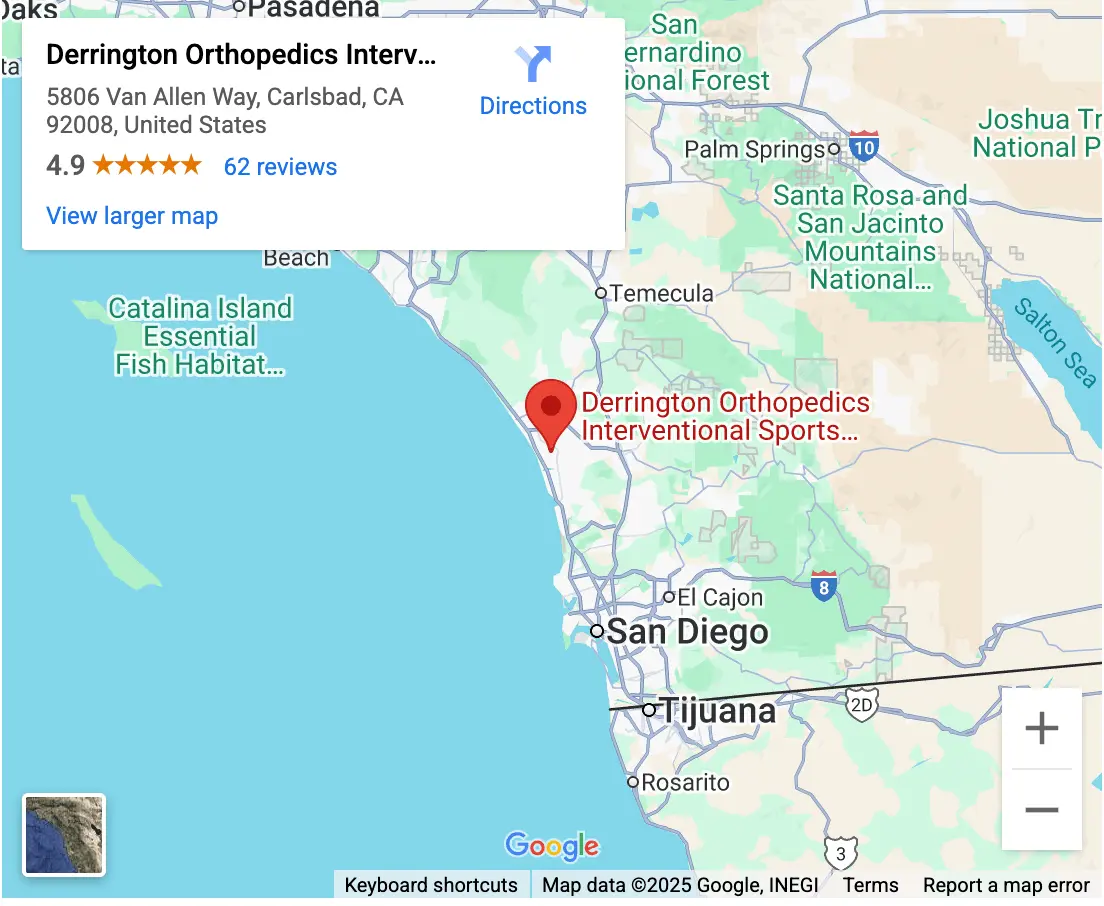
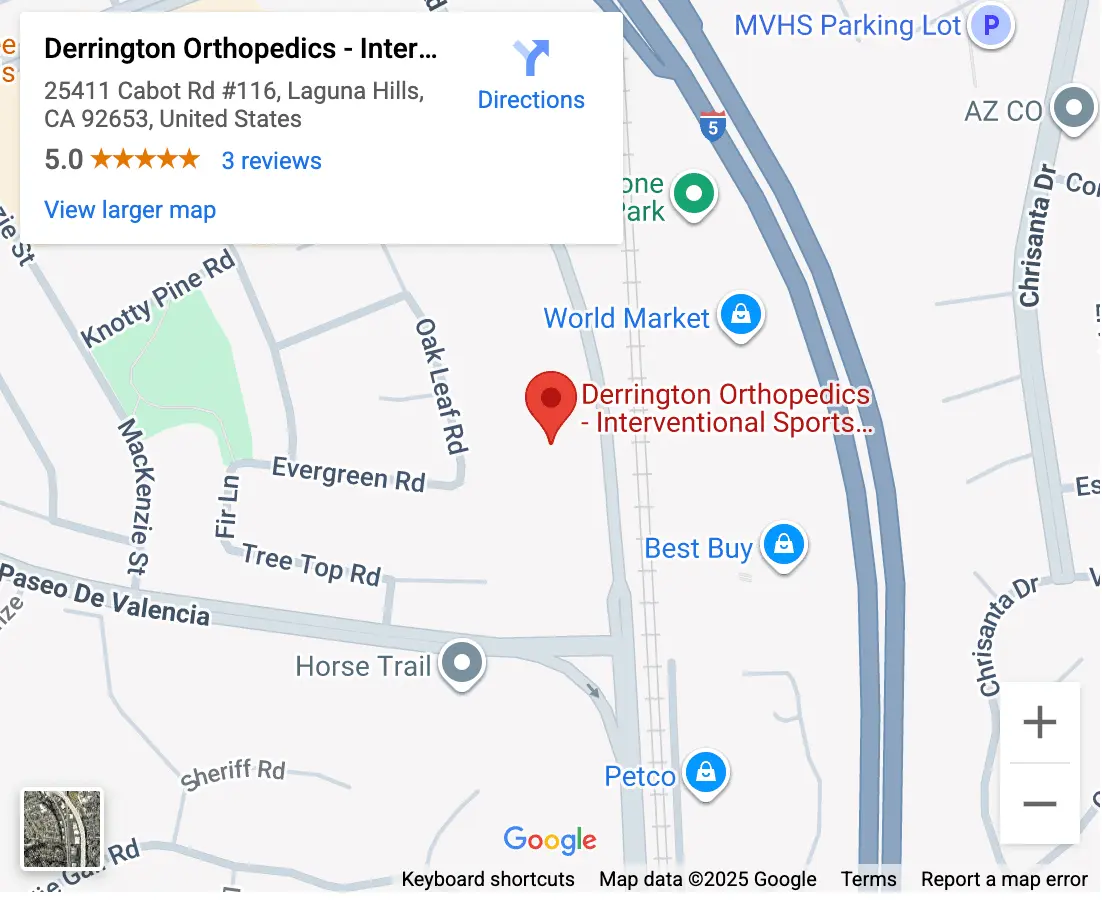
Dr. Derrington sees patients at the Carlsbad office (5806 Van Allen Way, Suite 101, Carlsbad, CA 92008) and on Tuesdays at the Laguna Hills office (25411 Cabot Rd, Suite 116, Laguna Hills, CA 92653). Both offices share one phone number: (760) 721-4000. You can also request an appointment online.
Frequently asked questions
Is bone marrow concentrate the same as stem cells?
Bone marrow concentrate contains stem cells, along with other cells and growth factors. It comes from your own pelvis and is prepared the same day. Products sold as “stem cells” from donor tissue, such as umbilical cord, are different.
Can I start with PRP and move to bone marrow concentrate later?
Yes, for many conditions. Dr. Derrington says: “Patients who are a little more cautious with how they progress through this decision process might start with PRP, and you might do really well.”
Is bone marrow concentrate stronger than PRP?
Dr. Derrington describes it as the stronger option for more advanced problems. In one randomized trial of mild to moderate knee arthritis, a single bone marrow concentrate injection did not outperform a single PRP injection (Anz et al., 2022). Your exam and imaging guide which one makes sense for you.
Which option is better for advanced knee arthritis?
Dr. Derrington tends to consider bone marrow concentrate for more advanced cartilage loss: “Now, when you want to think about going to something stronger, like using bone marrow concentrate, more advanced kind of conditions.” For some people with advanced arthritis, knee replacement is still the right choice, and a thorough evaluation should cover that too. Whichever you choose, recovery after PRP or bone marrow concentrate covers what to expect in the first days and months.
Sources
- Anz AW, et al. Bone marrow aspirate concentrate is equivalent to platelet-rich plasma for the treatment of knee osteoarthritis at 2 years. Am J Sports Med. 2022. PubMed 35289231
- Shapiro SA, et al. A prospective, single-blind, placebo-controlled trial of bone marrow aspirate concentrate for knee osteoarthritis. Am J Sports Med. 2017. PubMed 27566242
- American Academy of Orthopaedic Surgeons. Management of Osteoarthritis of the Knee (Non-Arthroplasty), Evidence-Based Clinical Practice Guideline, 3rd ed. 2021. Link
- Shapiro SA, et al. Quantitative T2 MRI mapping and 12-month follow-up in a randomized, blinded, placebo controlled trial of bone marrow aspiration and concentration for osteoarthritis of the knees. Cartilage. 2019. PubMed 30160168
- AAOS OrthoInfo. Platelet-Rich Plasma (PRP)
Medical disclaimer: This article is general education. It does not replace an exam or medical advice for your situation. Results from PRP and bone marrow concentrate procedures vary, and no treatment helps everyone. If you have sudden severe pain, a hot, swollen joint with fever, new weakness or numbness, or loss of bladder or bowel control, seek urgent medical care.