By Dr. Steve Derrington, DO | Board-Certified Interventional Sports & Spine Physician | Regenexx-Certified Provider
Reviewed: June 2026 | Est. read time: 9 minutes
| QUICK ANSWER Being told your knee is bone-on-bone does not automatically mean a knee replacement is your only option. Bone-on-bone describes advanced cartilage loss on imaging, and while it is a serious finding, how to treat it depends on far more than the X-ray, including how your knee actually functions, your activity goals, and how the surrounding structures are still working with you. For advanced cartilage loss, Derrington most often recommends a Rebuild treatment protocol, an image-guided Bone Marrow Concentrate combined with PRP, as an option for patients who want to delay or avoid a replacement. Some patients are strong candidates, and some are genuinely better served by surgery, which is exactly what a comprehensive evaluation is meant to determine. Seeing a non-surgical orthopedic specialist before committing to a replacement gives you a second, independent read on your knee from a physician whose entire practice is built around the options that come before the operating room. |
The orthopedic surgeon held up the X-ray, pointed to the narrow gap where cartilage used to be, and said the words you had been dreading, bone-on-bone. Then came the referral, the replacement timeline, and the sense that the decision had already been made for you.
It is a heavy moment, and it usually arrives after months or years of swelling, stiffness, and cortisone shots that helped for a while, or maybe only for a day, and then stopped helping. By the time someone hears bone-on-bone, they are often tired of managing the pain and unsure whether anything short of surgery is even worth exploring.
Here is what often gets lost in that appointment:
- Surgery is not the only path
- Cortisone is not the only injection
- A second opinion from a non-surgical orthopedic specialist is a different conversation than another surgical consult.
This article explores what ‘bone-on-bone’ actually means for your treatment options, the level of care typically suited for advanced knee arthritis, and how to determine if you are a candidate for non-surgical treatment before scheduling an irreversible operation.
What “Bone-on-Bone” Actually Means for Treatment Decisions
Bone-on-bone is shorthand for advanced cartilage loss, most often graded on imaging using the Kellgren-Lawrence scale, which runs from grade 1 (mild) to grade 4 (severe, with the joint space largely gone). When a surgeon says bone-on-bone, they are usually describing grade 3 to grade 4 changes, where the cushioning cartilage between the femur and tibia or patella and femur has worn thin. The term is sometimes used more loosely to describe any arthritis in general rather than severe wear. In our clinic, we have seen many patients who were told they were bone-on-bone whose imaging showed a much less severe condition than the term implies.
What matters for your treatment decision is that the X-ray grade and your actual function do not always match. Two people can have nearly identical grade 4 imaging, and one is walking without a limp while the other can barely walk. The image is one input, not the whole story.
An interventional orthopedic physician evaluates several variables the X-ray alone does not show:
- Alignment and mechanical load. A knee that bows inward (varus) or outward (valgus) keeps overloading the same worn compartment, which influences what needs to be addressed for a successful treatment.
- The condition of the surrounding structures. Meniscus tears, ligament injuries, and tendon health all factor in, because the joint does not fail in isolation.
- Inflammation and effusion. A hot, swollen knee with a large effusion is a different clinical picture than a stiff, dry, mechanically worn joint, and it affects treatment sequencing.
- Your goals. Returning to daily walking without pain is a different target than returning to singles tennis, and the plan is built around what you actually want to get back to.
This is where Derrington Orthopedics looks different from a surgery-first or cortisone-only path. As the largest Regenexx provider in Southern California, the practice uses image-guided procedures, meaning injections are placed under ultrasound or fluoroscopic guidance rather than by feel, so the biologic material reaches the precise target inside the joint. That precision can be the difference in a regenerative treatment being successful and failing. .
Which Treatment Fits a Bone-on-Bone Knee
Derrington matches the procedure to the actual stage of the condition rather than defaulting everyone to the same answer. Bone-on-bone knees usually sit at the more advanced end, but where exactly depends on the full evaluation, not the X-ray alone.
The Three Non-Surgical Procedures
Derrington uses three levels of non-surgical care, and the right one depends on how worn the knee is.
Recover is the gentlest option and uses no needles. It combines laser and infrared light therapy with topical care to calm swelling and ease pain, and it works best for knees in the early stages of wear. Some patients start here and move to an injection later if the knee needs more.
Restore is an injection that uses your own blood. The blood is spun in a lab to isolate and concentrate the platelets, which are the part of your blood that helps your body heal, and that concentrated fluid is placed into the exact spot in your knee using ultrasound or fluoroscopy to guide the needle. This is often the right fit for mild to moderate wear or a soft-tissue injury around the joint. You may see this called PRP, which stands for platelet-rich plasma.
Rebuild is the strongest non-surgical option and is the one usually considered for a more advanced arthritis, or bone-on-bone knee. It draws healing cells from your own bone marrow, combines them with the platelets from Restore, and places the mix into the joint under ultrasound guidance. The goal is to give an advanced knee more support than platelets alone can provide, as a way to delay or avoid a replacement. You may see this called BMAC, which stands for bone marrow aspirate concentrate. Wondering whether it regrows cartilage? Dr. Derrington answers that in can bone marrow injections regrow cartilage.
| Your Knee Profile | Commonly Matched Treatment Recommendations |
| Early cartilage loss (grade 1–2), intact meniscus, mild swelling | Recover |
| Moderate degeneration (grade 2–3), tendinopathy or partial soft-tissue involvement | Restore |
| Advanced cartilage loss (grade 3–4), bone-on-bone on imaging, structural wear | Rebuild |
| Severe deformity | Surgical evaluation recommended |
MLS Laser Therapy can be paired with any of these procedures to support recovery and is available at the Carlsbad location only. RedVive red and near-infrared light panels are used at home after any procedure to support inflammation control and tissue recovery.
| THINK OF IT THIS WAY A worn-down knee is like a road that has lost its surface. A full replacement is tearing out the road and pouring a new one, which is sometimes exactly what is needed. The Restore and Rebuild orthobiologic treatment approach is more like bringing in the right repair crew to work on the damaged area, supporting the joint so you can keep using it. The point of the evaluation is to figure out which job your knee actually needs, not to assume the most invasive one by default. |
Orthobiologics vs. Cortisone vs. Surgery — Understanding the Trade-Offs
By the time you are reading about a bone-on-bone knee, you are already weighing these three paths in your head. Here is an honest look at each.
Cortisone. Cortisone or steroid injections reduce inflammation quickly and can take the edge off a flared, swollen knee, which is why it is so commonly offered. It does not repair cartilage or change the underlying wear, the relief typically fades within weeks to a few months, and repeated use carries a higher risk of faster cartilage loss and tissue effects. It is a tool for short-term symptom control, not for long-term structural improvement.
Surgery. A knee replacement is a well-established operation and may be the right choice for people with end-stage joints, especially with severe deformity. It also brings real recovery time, surgical risk, and a permanent change to the natural anatomy of your knee. For the right candidate it can be life-changing, which is why evaluating fit honestly matters so much before committing to it.
Orthobiologics. Orthobiologics are biologic procedures that use your own platelets (PRP) or bone marrow cells (BMC), isolated and concentrated in a lab and delivered under image guidance, designed to support the body’s own repair response. For an advanced, bone-on-bone knee, the Rebuild procedure is the option typically recommended.The value is that it offers a path to delay or avoid a replacement for many years, with far less downtime than surgery.
What gives this comparison its credibility is that Dr. Derrington tells patients when surgery is genuinely the right call. A non-surgical practice that never recommends surgery would not be worth trusting. The goal of the evaluation is the honest answer, not a predetermined one.
How to Know If You’re a Candidate for a Non-Surgical Approach
No article can tell you whether you are a candidate, because that requires reviewing your imaging and examining your knee in person. What you can do is recognize the signals that make a conversation with a non-surgical specialist worthwhile. If several of these describe your situation, an evaluation is the logical next step:
- Imaging is not the whole picture. Your imaging shows advanced wear, and you want a specialist to assess how your knee is actually functioning before defaulting to surgery.
- Short-term relief only. Cortisone or steroid injections helped for a few days or weeks and then the pain returned, which tells you inflammation control alone is not solving the problem.
- Surgery presented as the single path. A replacement was offered as the only option, with little discussion of what comes before it.
- You want to stay active. You are active, or want to be again, and getting back to hiking, pickleball, or golf without limping is the real goal.
- Conservative care has run its course. You have tried physical therapy, bracing, or anti-inflammatories without lasting relief.
- You want to evaluate before you commit. You would rather explore a less invasive option first, knowing surgery remains available if it is the right answer later.
An advanced, bone-on-bone knee does not exclude you from this conversation, it routes you into a careful evaluation. The comprehensive evaluation is the only way to confirm whether an orthobiologic path makes sense for your specific knee, and some patients are told that surgery is the better choice for them. That honesty is the point. The evaluation determines fit.
What To Do Next
If you have been told you are bone-on-bone, you have likely been carrying that news with a quiet certainty that surgery is now inevitable. It is reasonable to be skeptical of anyone suggesting otherwise, especially after a cortisone shot that wore off or never worked, or a surgeon who framed replacement as the only road.
A consultation at Derrington Orthopedics is an opportunity to find out about what your options really are. You bring your imaging, a physician whose entire practice is built around the options before surgery reviews your knee with you, and you leave with a straight answer about whether a non-surgical path is realistic for your situation, or whether surgery truly is the better choice.
Either way, you will know more than you do now, and you will have made the decision with a full picture rather than a single X-ray.
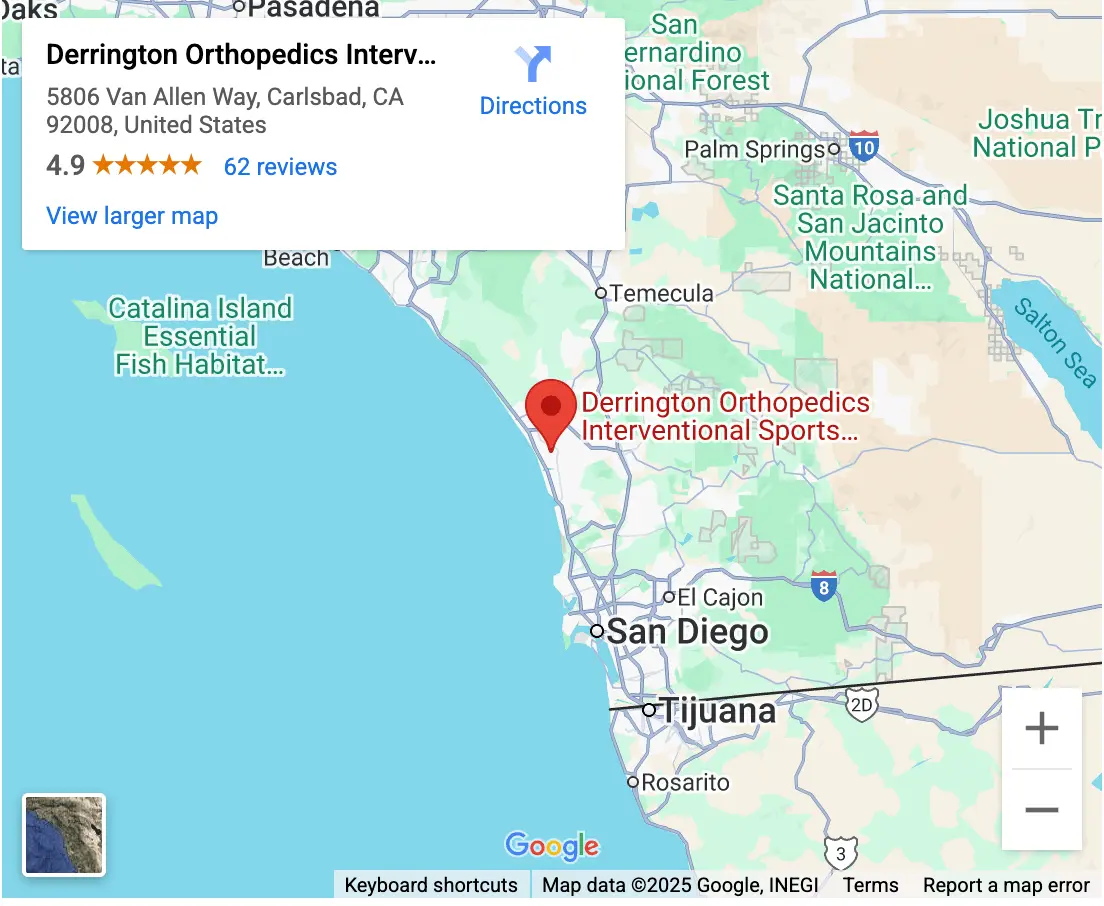
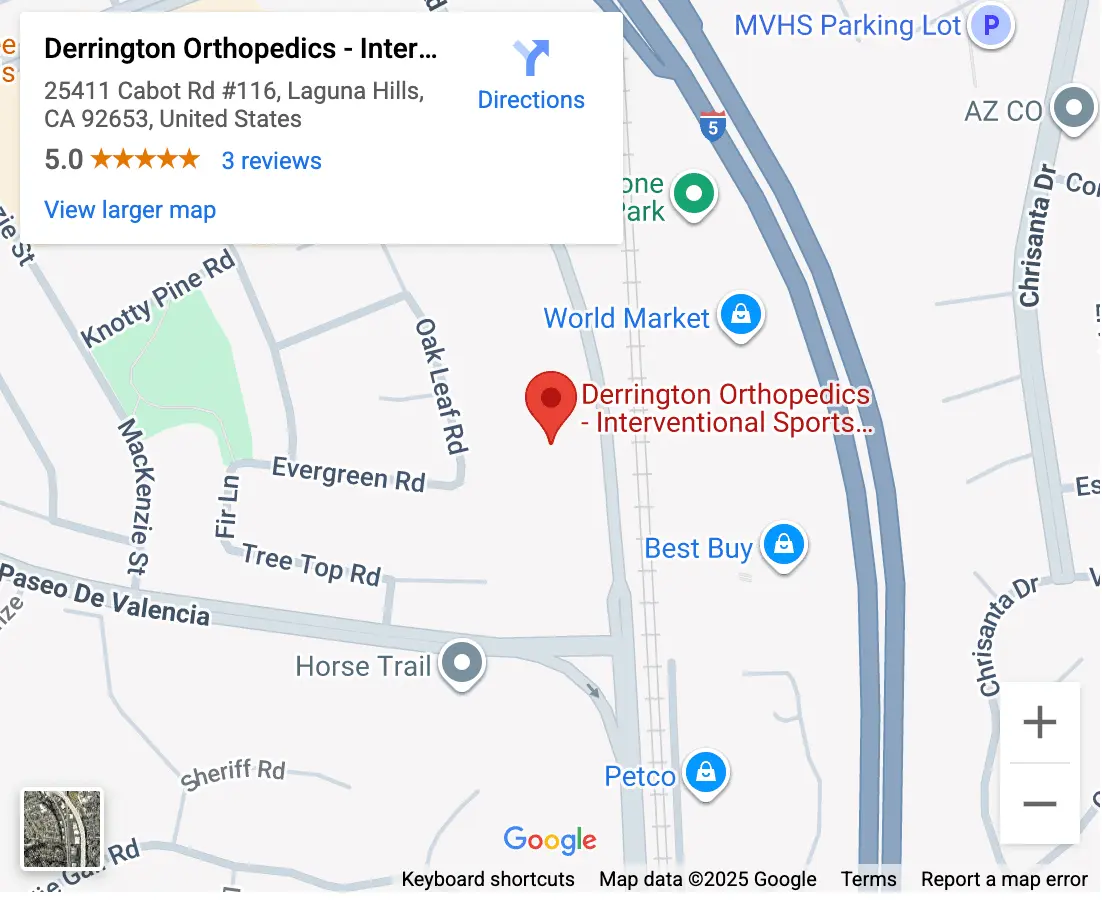
| READY TO FIND OUT IF YOU’RE A CANDIDATE? A comprehensive evaluation with Dr. Derrington includes a review of your imaging and a clear answer on whether an orthobiologic path makes sense for your knee. There is no pressure and no commitment to a procedure, just an honest assessment from a non-surgical specialist. Call (760) 721-4000 and a member of the team will walk you through what the evaluation involves and what it costs, or request a consultation online. Offices in Carlsbad and Laguna Hills, California. |
Frequently Asked Questions
Am I a candidate for non-surgical treatment if I’m already bone-on-bone?
Possibly, and the only way to know is a comprehensive evaluation. Advanced cartilage loss usually points to a Rebuild procedure, Bone Marrow Concentrate combined with PRP, evaluated as an option to potentially delay or avoid a replacement. Candidacy depends on how your knee functions, your alignment, the surrounding structures, and your goals, not the X-ray alone. Some patients are strong candidates and some are genuinely better served by surgery.
How is Dr. Derrington’s approach different from a standard orthopedic surgeon?
A surgeon’s training centers on the operating room, so the conversation often moves quickly toward replacement. Dr. Derrington is an interventional sports and spine physician whose entire practice is built around the non-surgical options that come before surgery, delivered with precise image guidance. The approach is to evaluate the full picture and recommend surgery only when the knee genuinely needs it.
What’s the typical recovery timeline after a Rebuild procedure for a knee?
Most patients return to daily activities within days rather than the weeks of recovery a replacement requires, with the biologic response developing gradually over the following months. Recovery varies by individual and by how advanced the knee is, which is why expectations are set during the evaluation. At the Carlsbad location, the practice often pairs MLS Laser Therapy to support the recovery process.
Does insurance cover orthobiologic treatment for knee arthritis?
Orthobiologic procedures like PRP and Bone Marrow Concentrate are not covered by insurance and are paid out of pocket. The specifics for your situation are reviewed during the consultation. This is one reason the evaluation matters, so you understand the realistic path before making any financial decision.
What does the consultation include?
It is a comprehensive evaluation with Dr. Derrington that includes a review of your existing imaging, an examination of your knee, and a clear answer on whether a non-surgical orthobiologic path is realistic for you. When you call, a member of the team will walk you through exactly what the evaluation involves and what it costs, because that is easier to understand in a real conversation than as a number on a page. You leave with a straight assessment, not a sales pitch, and if surgery is the better option for your knee, you will be told that directly.
How is Regenexx PRP and BMC different from what other clinics offer?
The difference is in the lab process. Rather than the standard bedside preparation many clinics use, the Regenexx lab process is designed to produce a higher, more consistent concentration of your own platelets or bone marrow cells, and every procedure is delivered with ultrasound or fluoroscopic guidance for precise placement. Derrington Orthopedics is the largest Regenexx provider in Southern California.
What if I’ve already had PRP or injections elsewhere and they didn’t help?
That is worth discussing rather than assuming the door is closed. Results depend heavily on the volume of blood drawn, the concentration of the biologic material, the precision of placement, and whether the right procedure was matched to the stage of your knee. A prior injection that did not help does not automatically rule out a different, image-guided approach, and the evaluation is where that gets sorted out honestly.
Is it too late to avoid a knee replacement if surgery has already been recommended?
A surgical recommendation is a reason to get a second, independent opinion, not a reason to skip one. Seeing a non-surgical specialist before scheduling surgery gives you a fuller picture of your options, and the evaluation will tell you whether a non-surgical attempt is realistic or whether the replacement your surgeon recommended is in fact the right path for your knee.